
📌 Quick Facts About Tuvalu 🇹🇻
Tuvalu was my 180th country visited on my journey to every country in the world, and reaching it honestly felt like an achievement by itself. It was also the final stop of my Oceania trip, apart from Palau, which I intentionally saved as the very last country of the entire project.
Unlike some countries, Tuvalu is not difficult because of visas. Most nationalities can enter visa-free. The real challenge is simply getting there.
- 🏛️ CapitalFunafuti
- 💵 CurrencyAustralian dollar (AUD)
- 🗣️ LanguageTuvaluan and English
- 🌡️ ClimateTropical marine
- 🔌 Plug typeType I · *Anker Universal Travel Adapter
- 🌺 RegionPolynesia, Oceania
✈️ How to Get to Tuvalu
There is only one airline flying to Tuvalu: Fiji Airways. They essentially have a monopoly on the route, which means flights are usually extremely expensive for such a short distance. I personally paid around €900 for a return ticket.
The logistics are also surprisingly complicated. Most international travelers first arrive in Nadi, Fiji's main international airport. But flights to Tuvalu do not leave from there. Instead, you have to get to Suva, Fiji's capital, and fly onward from there to Funafuti, the capital of Tuvalu.
And yes, the airport code for Funafuti is literally FUN. After 180 countries, I finally arrived somewhere with the airport code FUN, which honestly felt pretty fitting.
Even once you have a confirmed ticket, nothing is guaranteed. Several travelers had warned me beforehand that people occasionally get bumped off flights due to weight restrictions on the aircraft. Since Tuvalu imports a huge amount of supplies through these small planes, cargo sometimes takes priority. That means even passengers with proper bookings can end up stranded in Fiji for several extra days waiting for the next available flight.
Simply reaching Tuvalu already feels like a mission. But once you finally land there, everything suddenly becomes incredibly simple.
🏨 Where to Stay in Funafuti: Filamona Lodge
I stayed at Filamona Lodge, one of the more budget-friendly accommodation options on Funafuti. It was very basic, but perfectly fine for a short stay.
I only spent two nights in Tuvalu, giving me essentially three days on the island. One thing that immediately stood out was how tiny and surreal everything felt.
- Accommodation: Filamona Lodge.
- Stay length: 2 nights, roughly 3 days on the island.
- Currency: Australian dollars.
- Tip: bring cash, because card payments are not always reliable.

🛵 Exploring Funafuti by Foot and Scooter
On my first day, I simply explored Funafuti by foot. Calling it a “city” almost feels wrong. It is more like a tiny village stretched along a narrow strip of land in the Pacific Ocean. Everything is incredibly close together. Within about 20 minutes, you can walk through most of the main settlement.
Right next to each other, you will find government buildings, small local stores, the National Bank of Tuvalu, simple restaurants, and houses. At the bank, I exchanged money into Australian dollars, which Tuvalu uses as its currency.
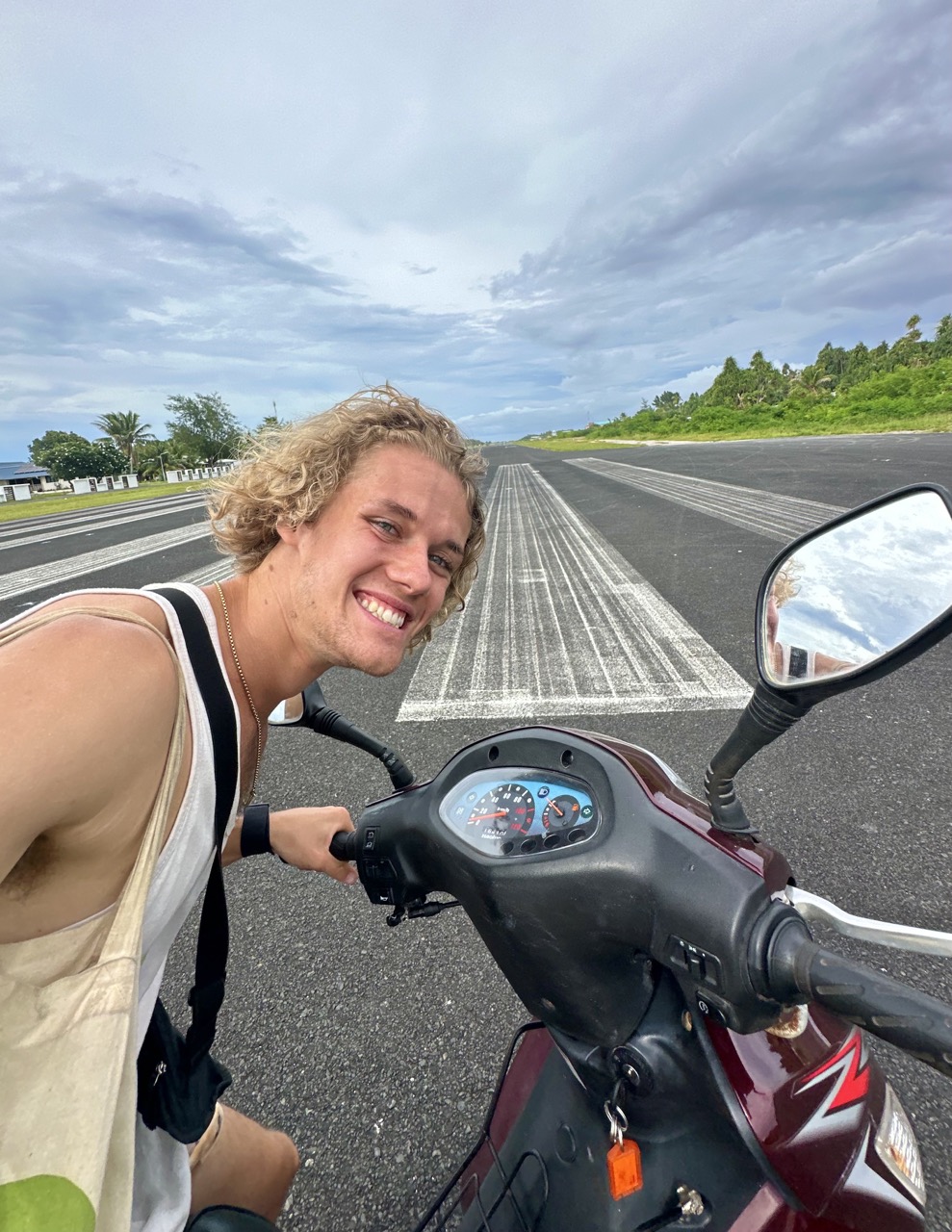
To get around the atoll more easily, I rented a scooter directly from my accommodation for around €5-7 per day. Honestly, a scooter is probably the best way to experience the island. The roads are flat, distances are short, and driving through Funafuti feels incredibly relaxed compared to almost anywhere else in the world.
🛫 The Funafuti Airport Runway
You can literally walk from the airport runway directly to your accommodation within minutes. In fact, the runway itself becomes one of the island's main public gathering places whenever there are no flights.
Since planes only arrive a few times per week, locals use the airport area as a social hub. In the evenings, people gather there to play sports, hang out with friends, walk around, and spend time together. It is probably one of the only places in the world where an international airport casually turns into a community park every evening of the week.
That first evening became one of my favorite memories from Tuvalu. I spent hours hanging out with locals on the airport runway while the sun slowly disappeared over the Pacific. Kids were playing sports, families were walking around, and people were simply enjoying the evening together in what is technically an active international airport.
At one point, one of the local kids suddenly recognized me from my travel videos online, which completely surprised me considering how remote Tuvalu is. After traveling to 180 countries, moments like that still feel surreal.


🥥 Trying Fekei in Tuvalu
The experience that truly made Tuvalu unforgettable happened the next day. One of my main goals on the island was surprisingly simple: I wanted to try fekei, a traditional Tuvaluan dish that you can pretty much only find in Tuvalu.
As someone who loves trying local food everywhere I travel, I became weirdly determined to find it. The problem was that nobody seemed to have it. I asked at basically every restaurant and small food place I could find around Funafuti, but nobody served fekei.
After a while I realized why: on islands like Tuvalu, many traditional foods are not really “restaurant food.” They are mostly prepared at home or for special occasions and ceremonies. So I started asking random people on the street: “Do you know where I can try fekei?”
🌺 A Tuvaluan Funeral Ceremony
Eventually, one woman told me something completely unexpected: “There is a funeral tomorrow evening. You can come there and try it.”
I honestly did not know how to react at first. Being invited to a funeral as a foreign traveler felt incredibly unusual, and I spent a long time debating whether going would be respectful or inappropriate. In the end, I decided to go, and it turned into one of the most fascinating cultural experiences I have ever had while traveling.
What surprised me most was how differently death was approached compared to many Western cultures. The atmosphere was not centered purely around grief or silence. Instead, it felt much more like a celebration of life. People sang together, shared stories, laughed, and spent time as a community honoring the person who had passed away.


👑 Sitting With the Chiefs
The ceremony took place inside one of the main community halls in Funafuti and lasted around three hours. Everything was conducted entirely in Tuvaluan. As somebody deeply interested in languages and linguistics, it was fascinating just sitting there listening to speeches, folk songs, conversations, and stories in a language I had never heard spoken extensively before. I did not understand a single word, but the atmosphere itself communicated so much.
In the very beginning of the event, one of the traditional chiefs came up to me. I got a little nervous. But instead of questioning why I was there, he invited me to come forward and sit next to him at one of the pillars in the hall's center.
Apparently, according to the local customs, that effectively made me one of the highest-ranking people in the room for the evening. People later joked that I had basically become part of the chiefs for one night.
It honestly felt very awkward at first because I absolutely did not want to disrespect local traditions, but everyone kept insisting that if the chief invited me to sit there, then accepting it was the respectful thing to do. And with that position apparently came privileges. When the enormous buffet opened, I was allowed to eat almost immediately after the leading chiefs.
Finally, after searching all over Tuvalu for it, I got to try fekei. It was absolutely worth the search.
The food overall was also surprisingly vegetarian- and vegan-friendly, which I had not necessarily expected before arriving in Tuvalu. Fekei itself is vegan by default, which made me even happier.

🛵 Driving Around the Island
The rest of my time in Tuvalu was spent doing something very simple: driving around the island endlessly on my scooter.
From one end of Funafuti to the other only takes around 26 minutes. I probably did that drive four or five times during my stay. Because honestly, what else do you do in Tuvalu? You explore. You slow down. You talk to people. You enjoy the atmosphere.
There is something fascinating about how isolated Tuvalu feels while still being so connected socially. Everybody seems to know each other. People wave at you constantly as you pass by. Children play outside everywhere, and there is a calmness to daily life that feels very different from most countries.
💭 Final Thoughts on Visiting Tuvalu
Tuvalu often gets described online as boring, but I honestly disagree with that completely. I have visited island nations that personally did not leave a strong impression on me. Nauru, for example, was not really my favorite experience. But Tuvalu was different.
The people were incredibly friendly, the atmosphere felt peaceful, and the whole place had a strangely calming energy to it. There are not many attractions in the traditional sense. No giant landmarks. No luxury resorts. No endless bucket-list activities.
But that is also exactly what makes Tuvalu special. It feels authentic, isolated, and deeply human in a way that very few places still do. Even though it is expensive and difficult to reach, I would absolutely love to return to Tuvalu one day.
Looking back, it still feels surreal that my search for a traditional dish ended with me attending a Tuvaluan funeral ceremony as an honored guest. That is the kind of thing you simply cannot plan while traveling.