
📌 Quick Facts About Sudan 🇸🇩
Sudan is an incredibly fascinating country with a huge amount of history and culture. One thing many people do not realize is that Sudan actually has more pyramids than Egypt. Most of them are located in the ancient Nubian regions of the country, especially around Meroë.
The country also has a long Red Sea coastline, a mix of Arab and African cultural influences, and historically served as an important crossroads between North Africa and Sub-Saharan Africa. Sadly, most of these places are currently off limits because of the war. During my visit, travel was restricted almost entirely to Port Sudan and nearby areas.
- 🏛️ CapitalKhartoum
- 💵 CurrencySudanese pound (SDG)
- 🗣️ LanguageArabic and English
- 🌡️ ClimateHot desert and semi-arid
- 🔌 Plug typeType C and Type D · *Anker Universal Travel Adapter
- 🕌 ReligionMostly Islam
⚠️ Is Sudan Safe to Visit Right Now?
Ironically, Sudan ended up being even more difficult for me to visit than North Korea, which had been country number 193.
The reason is simple: Sudan is currently in the middle of a devastating and extremely complicated war. Large parts of the country are completely inaccessible, many regions are unsafe, and even obtaining a visa can be very difficult. For a long time, tourism in Sudan had essentially stopped entirely.
This guide is based only on my short visit to Port Sudan and nearby areas. It is not a recommendation to travel independently through Sudan right now. Conditions can change quickly, and anyone considering a trip should check current travel advice, work with trusted local contacts, and understand the risks before making plans.
Sudan was not memorable because it was easy. It was memorable because of the people who welcomed me during an incredibly difficult time for their country.
✈️ My Route Into Sudan
I flew into Port Sudan from Jeddah in Saudi Arabia and later left the country on a flight to Cairo, Egypt. The entire trip was organized together with a local guide and his team, who handled all the logistics and visa arrangements for me.
At the moment, organized travel is basically the only realistic way to visit Sudan safely. My guides organized the invitation letter, visa process, airport pickup, transportation, and accommodation. Most things were handled on arrival. It took some patience, but in the end everything worked out surprisingly smoothly.
- Fly from Jeddah to Port Sudan.
- Receive the visa on arrival with an invitation letter.
- Base yourself in Port Sudan with a local guide.
- Visit the city, market, villages, beaches, and Red Sea coastline.
- Fly from Port Sudan to Cairo.
I was lucky enough to be among the first foreign tourists to return to Port Sudan after things had partially reopened. Because of the war, many locals I met had not seen international visitors in years.


🏨 Where to Stay in Port Sudan: Marina Hotel Port Sudan
Outside the airport, my guide was waiting for me. He turned out to be an incredibly knowledgeable and kind person. Interestingly, he had studied in Germany before, so he even spoke a fair amount of German, which immediately made conversations easier and more personal.
Our first stop was my hotel: the Marina Hotel Port Sudan. The hotel was honestly much nicer than I expected. It sits directly in front of the harbor, so you can look out over the water from the property. Considering the circumstances in Sudan right now, it felt surprisingly comfortable and calm.
- Accommodation: the Marina Hotel Port Sudan.
- Location: directly by the harbor.
- Comfort: much better than I expected given the situation.
- Internet: the Wi-Fi was genuinely good, which shocked me.
📱 Internet in Sudan: eSIM Coverage
Getting connected in Sudan is not as straightforward as in most countries. Many eSIM providers do not offer Sudan coverage at all, which makes planning a little more annoying if you want mobile data before or during your arrival.
Unlike most eSIM providers, 195sim actually has Sudan coverage. If you want to check the current plan options before your trip, you can see the *Sudan travel eSIM on 195sim.
👀 First Impressions of Port Sudan
Honestly, my first impression surprised me. Given the situation in the country, I expected complete chaos when arriving at the airport. But the process was actually very organized and straightforward. There was no corruption, nobody trying to scam me, and everything was handled professionally.
I presented my invitation letter, received the visa on arrival, and entered the country without any major issues. After quickly dropping my bags at the hotel, we immediately headed into the city.
🕌 The Grand Mosque and Central Market in Port Sudan
Our first stops were the Grand Mosque of Port Sudan and the central market area nearby. This was where things became really interesting for me.
People were incredibly excited to see a foreign tourist again. Because of the war, tourism had essentially disappeared, and many people told me they had not seen international visitors in years. Instead of being suspicious or hostile, most people were extremely welcoming and grateful that someone had still chosen to visit Sudan despite everything happening in the country.
Walking through the market felt chaotic in the best possible way. It was crowded, loud, messy, and full of life. Small food stalls lined the streets, vendors shouted to attract customers.
I was constantly invited to try food. One falafel vendor insisted on giving me falafels for free. Another man selling lentils on the street invited me for some free lentils. I wanted to pay, but he insisted I should not, because I am a guest. Everywhere we walked, people smiled, waved, and wanted to talk.
Before entering Sudan, I received backlash online from people who thought visiting during the conflict was inappropriate or too dangerous. Once I was there, the reaction from locals felt completely different: people seemed genuinely happy that foreigners had not forgotten Sudan.
🌙 A Ramadan Evening Outside Port Sudan
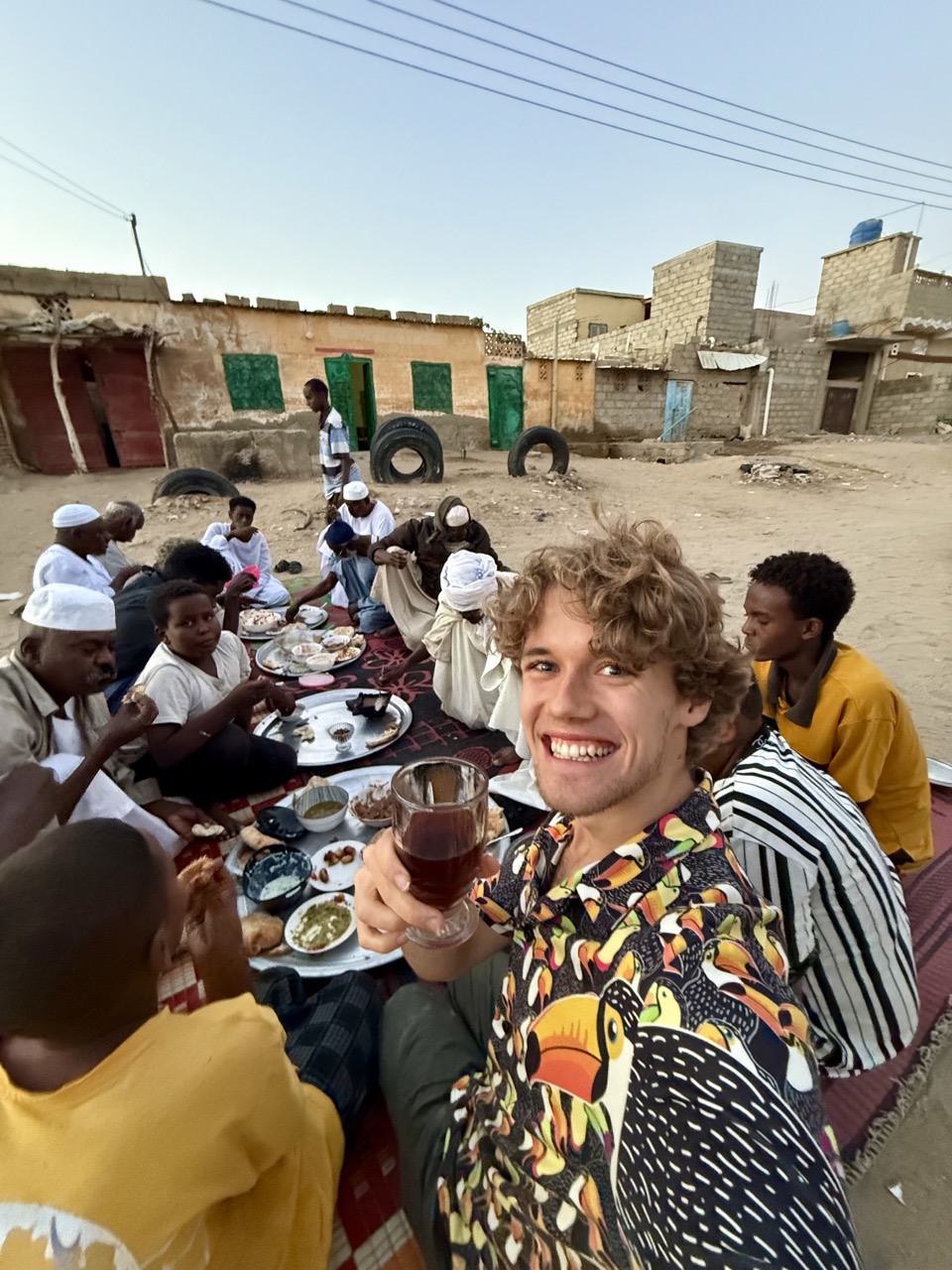
In the evening, my guide took me to a small village outside Port Sudan where some of his family members lived. Because it was Ramadan, the entire atmosphere felt very special.
The village had organized a large communal fast-breaking dinner for sunset. Families rolled carpets directly into the middle of the street, completely blocking the road, and everybody gathered together to share food after the daily fast.
The meal itself was extremely communal. Everyone sat close together and ate with their hands from shared dishes. Definitely not an environment for people who are overly afraid of germs, but for me it felt like a very authentic and beautiful experience.
Even more than the food itself, I remember the atmosphere. Children were running around everywhere, the men on the carpet laughed at my attempts to eat the Sudanese dishes (and filming everything), and despite all the difficulties Sudan is currently facing, there was still this incredible sense of warmth and community.
- 🍽️ I tried asida, a traditional Sudanese dish with a thick consistency.
- 🌙 I also tried a sweet date soup.
- 🥤 There was a local Sudanese drink I had never seen anywhere else.
- 🤹 After dinner, I ended up juggling with the children in the village.
As always, juggling became an instant universal language. Within minutes, the kids were trying tricks themselves, laughing, and completely fascinated. It was such a surreal contrast: spending the evening juggling with children in a village in Sudan while the country around us was going through one of the most difficult periods in its modern history.
🌊 Day Two in Port Sudan: Beaches, Boats and the Red Sea
My second day in Sudan felt completely different from the first one. While the first day had been focused more on the city, markets, and cultural experiences, the second day honestly had much more of a holiday feeling to it. That was something I really did not expect before visiting Sudan.
Port Sudan actually has a beautiful coastline. The beaches along the Red Sea were surprisingly nice, with crystal-clear water, warm temperatures, and amazing weather. If you completely ignored the political situation for a moment, it genuinely felt like a destination that could attract a lot of tourists in the future.
Before heading to the beach, we visited the local fish market. Since I do not eat fish, I obviously did not buy anything there, but it was still very interesting to walk around and observe daily life. The market was significantly less busy than the city center, and full of freshly caught fish being sold directly by local fishermen.


⛵ Boat Trip and the Underwater Aquarium in Port Sudan
After spending time at the market, I decided to do a small boat tour along the coastline. There are local boat captains who offer short trips out onto the Red Sea, and it ended up being one of the highlights of the trip for me. I paid around 30 Euros for that trip.
The weather that day was extremely windy. The waves were honestly pretty crazy, and at first I thought I would skip snorkeling entirely because it looked slightly dangerous. Eventually, I did briefly go snorkeling for a short time, but because of the wind and rough water, visibility was not particularly great that day.
Still, the boat ride itself was fantastic. Sitting on the boat, feeling the wind, and looking back at the coastline of Port Sudan was such a surreal experience. Sudan was one of the last countries of my entire world journey, and somehow I had never imagined myself sitting on a boat in the Red Sea off the coast of Sudan.
One of the coolest things we visited during the trip was something called the underwater aquarium. I had never seen anything like it before anywhere in the world. Basically, there is a reef area near the shoreline where they built a sort of glass observation container directly into the water. You arrive there by boat, walk down some stairs into the structure, and then you can observe the reef and marine life through large glass windows while the fish swim freely outside.
It is essentially like a wild aquarium in the middle of the ocean. Out of all the countries where I expected to find something unique like this, Sudan would probably have been one of the last.
🧭 Trip Organization and What I Could Not Visit
Originally, I had hoped to explore more of Sudan. There is a beautiful historic port town on the Red Sea called Suakin that I would have loved to visit as well, but even that area was off limits because of the conflict situation at the time. So my entire trip focused on Port Sudan itself and the surrounding villages.
After returning from the boat tour, I walked along the beach a bit more and bought a small souvenir from local vendors selling things along the street. Later, I went back into the city, grabbed some more falafel sandwiches, and walked through the market one final time. I also bought some dates before heading back to prepare for my departure. That evening, I took my flight from Port Sudan back to Cairo.
If you are interested in doing the same trip that I did, including the exact guide and contacts I used, I will link all the information in my trip organization section below.
💭 Final Thoughts on Visiting Sudan
My time in Sudan was short, and because of the conflict, I only got to experience a very small part of the country. I still hope that one day I can return and properly explore everything Sudan has to offer, especially places like the pyramids and other historical sites that are currently inaccessible.
But despite the difficult situation the country is facing right now, I genuinely had an incredible experience there. The thing I will remember most about Sudan is not the conflict or the logistical difficulties of entering the country. It is the kindness of the people.
From the market vendors giving me food for free, to families welcoming me into their Ramadan dinner, to children laughing while trying juggling tricks, those are the memories that stayed with me. Sudan turned out to be one of the most unexpected and fascinating final stops of my journey to every country in the world.
📄 Want the Same Sudan Guide Contact?
If you want to organize a similar Port Sudan trip, I am offering a short PDF with the local guide contact I used for $4.99. The trip itself will cost around 1000 EUR depending on your exact route, timing, and what you arrange directly with the guide. Thank you for supporting my blog!
Buy Sudan Guide Contact