
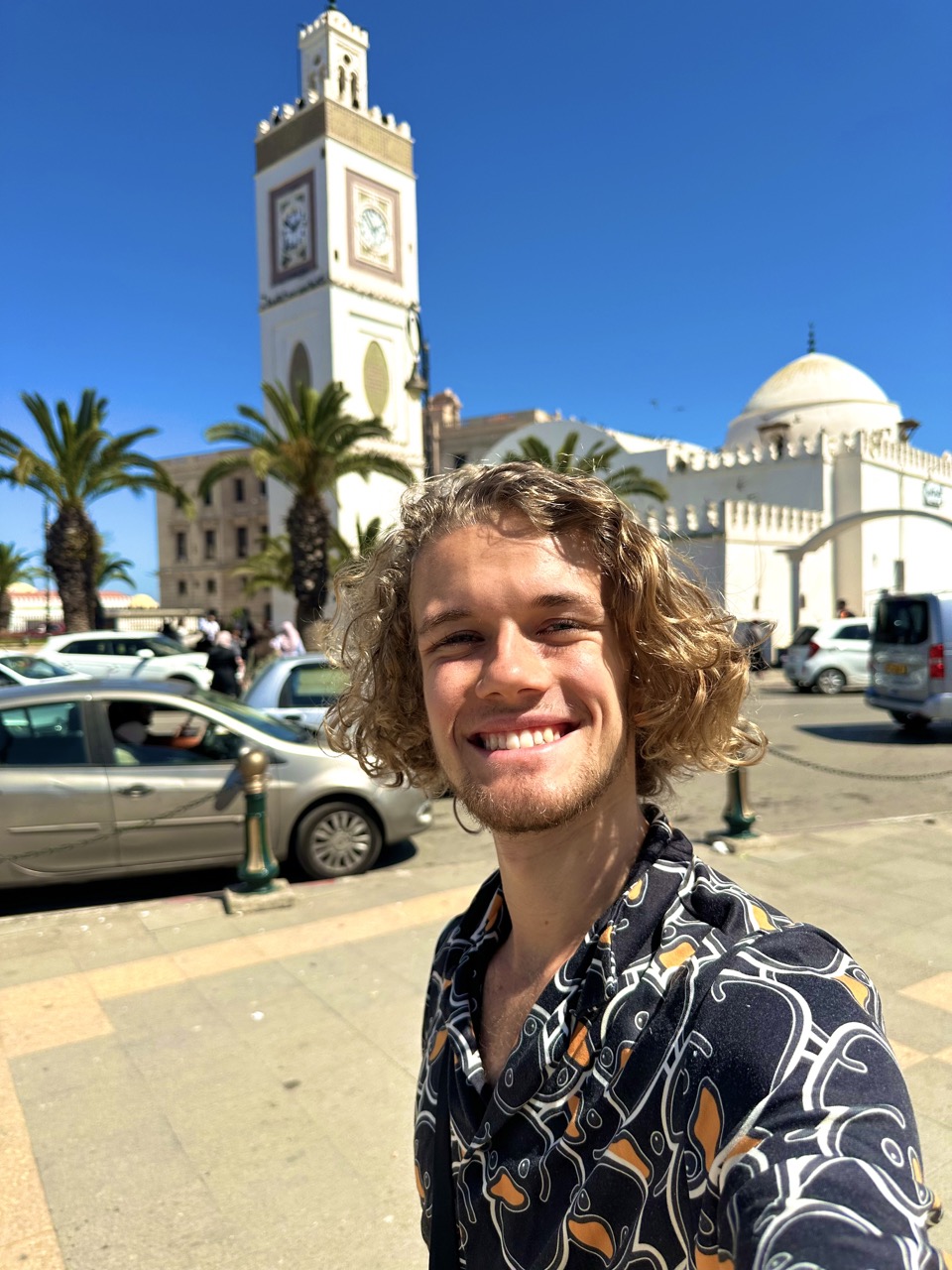
📌 Quick Facts About Algeria 🇩🇿
Algeria is the largest country in Africa, the largest Arab-majority country in the world, and home to a huge stretch of the Sahara Desert. It is right next door to Europe, yet for almost all nationalities it is much harder to visit than neighboring Morocco or Tunisia because of visa requirements.
I focused entirely on Algiers during this trip. The city surprised me with its French colonial architecture, North African atmosphere, food, beautiful gardens, and a feeling of being far less touristy than many nearby countries.
- 🏛️ CapitalAlgiers
- 💵 CurrencyAlgerian dinar (DZD)
- 🗣️ LanguagesArabic and Tamazight; French widely used
- 🌍 RegionNorth Africa
- 🔌 Plug typeType C/F · *Anker Universal Travel Adapter
- 🕌 ReligionIslam
🛂 Getting an Algerian Visa Was Not Easy
Algeria was one of the more challenging countries visa-wise. I actually had to apply twice before finally getting the visa.
My first application at the Algerian consulate in Frankfurt failed immediately. I had traveled several hours by train, only to be told that my application was incomplete. They barely looked at the paperwork before rejecting it because I was apparently missing required documents.
About a year and a half later I tried again. This time I arrived fully prepared with every document they could possibly ask for. It still took time, but eventually the visa was approved and I finally made it to Algeria.
🌙 Flying From Tel Aviv to Frankfurt to Algiers
I flew into Algeria from Frankfurt, Germany, and later flew back to Frankfurt as well. There was one unusual detail, though: earlier on the same day, I had actually been in Tel Aviv, Israel.
I flew from Tel Aviv to Frankfurt in the morning and then continued to Algiers on a separate booking. That is definitely not a route many people fly, and it would later cause me some problems online.
I arrived in Algiers at night and my first impression was extremely positive. I took a taxi from the airport into the city and then did something I rarely recommend: I searched for accommodation after arrival.
I found a hotel in the city center for 27 Euros per night (Grand Hôtel National). It
was very basic and did not have Wi-Fi in the rooms, so I only stayed for one night. I then changed to "The Post Hotel," which was a bit nicer.
Here are some better hotel options in Algiers:
- Sofitel Algiers Hamma Garden: a more comfortable option close to the gardens.
- Hotel El Aurassi: one of the best-known hotels in Algiers.
- AZ Hôtels Vieux Kouba: a practical option if you want reliable comfort and internet.

🗣️ Arabic, Tamazight, French and Tifinagh
Algeria reminded me of an older version of France. Algiers often felt like what I imagine Paris may have looked like decades ago. The French influence is everywhere: in the architecture, cafés, bakeries, and parts of daily life.
Linguistically, the country is fascinating. Arabic and Tamazight, also known as Berber, are the official languages of Algeria. Tamazight became an official language in 2016, while French, despite being spoken almost everywhere, has no official status.
Throughout Algiers you often see signs written in Arabic, Tamazight, and French. The Tamazight script, known as Tifinagh, looks incredible. It almost looks like mysterious symbols from another world.

🥣 Vegan Food in Algeria: Loubia and Mhadjeb
Food-wise, Algeria is not the easiest as a vegan. It's not impossible though, and there exist quite some local dished that are vegan by default. One of my favorite dishes was loubia, a traditional white bean stew.
My favorite place was a restaurant called Roi de la Loubia, which specializes almost entirely in loubia and a few simple local dishes. They serve it with bread and salad, and it was absolutely delicious. It is listed on HappyCow, an app I use everywhere.
I also tried Mhadjeb, a popular Algerian street food. It is a thin
flatbread filled with tomatoes, onions, and peppers, almost like a North African
stuffed pancake. It cost around 35 cents when I visited.
Another famous street snack is pizza, and you will often find versions without cheese.

🏙️ Exploring Algiers, the Casbah and Grande Poste
I spent much of my time exploring the center of Algiers. I visited Place des Martyrs, wandered through the old Casbah, explored narrow alleyways, and walked through markets selling everything from food to toys to household items.
The Casbah is probably the most fascinating area of the city and is recognized as a UNESCO World Heritage Site. Algiers has a unique atmosphere, combining French colonial architecture with North African culture.
I also visited the Grande Poste, one of the most iconic buildings in Algiers. Around the city there are cafés everywhere, street musicians, small art displays, and beautiful boulevards.


🌴 Jardin d'Essai du Hamma and the Waterfront
My favorite place in Algiers was definitely the Jardin d'Essai du Hamma. It is one of the most beautiful gardens I have ever visited in a capital city.
Massive staircases, palm trees, carefully maintained pathways, and beautiful views make it an amazing place to spend an afternoon. My second favorite area was the waterfront. Walking along the Mediterranean coast in the evenings was one of the highlights of the trip.
That said, Algiers is not perfect. Some areas, particularly around certain markets, have a noticeable trash problem. While much of the city is beautiful, there are places where litter is unfortunately quite visible.

📹 Algerian TV, Hebrew Videos and Online Backlash
One funny experience was that I ended up being interviewed on Algerian national television. A TV crew was conducting street interviews and randomly stopped me while I was walking through the city. I answered a few questions and probably ended up appearing on television somewhere in Algeria.
The more controversial part came later. Because I speak Hebrew, I decided to film several videos in Hebrew while exploring Algeria. I have many followers from Israel, and since they cannot visit Algeria, I thought it would be interesting to show them what the country looks like.
I did not upload the videos while I was inside Algeria. Only after leaving did I post them. In some videos, I spoke about Algeria's Jewish history. Before independence, Algeria had a Jewish population of well over 100,000 people. Today only a tiny community of around 100 remains.
The reaction online was far more intense than I expected. An Algerian influencer with
over a million followers shared one of the videos, and suddenly I received thousands of
hate messages and death threats because I had spoken Hebrew while visiting Algeria.
And I am not even Jewish or Israeli. I can only image what it would be like for a Jewish person to visit Algeria.
Another incident happened during a taxi ride, when the driver asked me where I was from. When I said Germany, he started talking about Hitler and how much he admired him. Sadly, those experiences are common across Arab countries.
After visiting every country in the world, I strongly believe Golda Meir was right: "Peace will come when the Arabs will love their children more than they hate us."
To this day, I genuinely do not know whether I will ever be able to return to Algeria.

💭 Final Thoughts on Visiting Algeria
Algeria has so much more to offer than just Algiers. There is the Sahara Desert, ancient Roman ruins, coastal cities, mountains, and enormous cultural diversity. Personally, I had already visited the Sahara in many other countries, so I focused entirely on Algiers during this trip.
Before leaving, I bought some Algerian dates, explored the city one final time, and then flew back to Frankfurt.
Algeria remains one of the most fascinating countries I have visited in North Africa. It is challenging visa-wise, not particularly touristy, and often misunderstood. But if you do manage to visit, you will find beautiful architecture, tasty food, fascinating history, and a country that feels completely different from its more touristic neighbors. Just maybe don't film Hebrew videos.
